
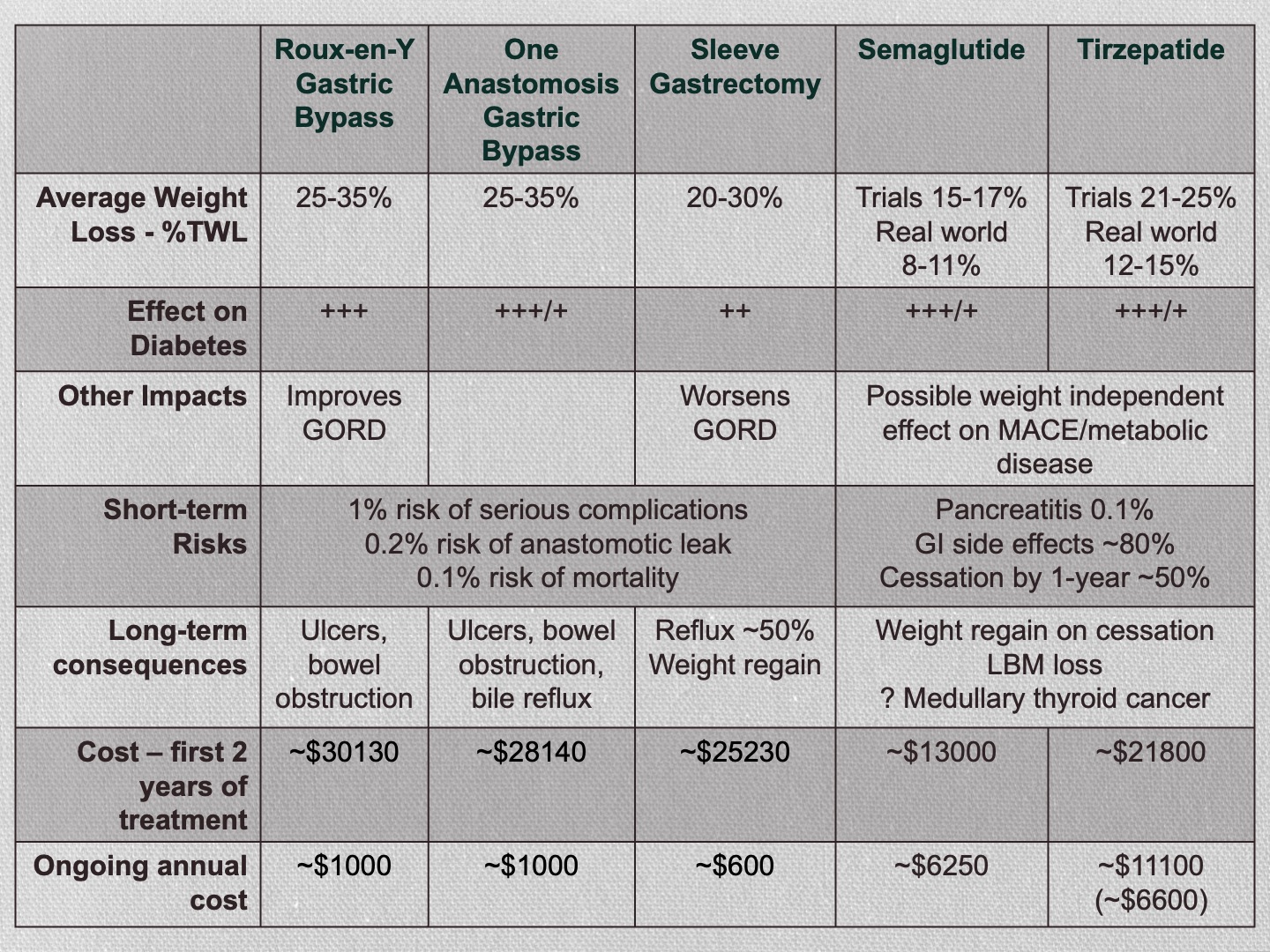
Every year, I give a lecture to medical students at the University of Otago on bariatric surgery. This year, with the availability of the new GLP-1 receptor agonist medications, semaglutide/Wegovy and tirzepatide/Mounjaro, I re-wrote my talk to include the role of these medications. There is no doubt that these medications are effective in helping people lose weight, improve their health, and quieten their ‘food noise’; however, there are important differences to consider when comparing the results of GLP-1 receptor agonists and bariatric surgery. To briefly summarise the extensive literature review that went into the preparation of the above slide, these are:
- The average weight-loss outcome with GLP-1 receptor agonist medications is less than with bariatric surgery
- However, GLP-1 receptor agonist medications appear to have an additional protective effect on the heart and kidneys, above what one would expect with weight loss alone
- GLP-1 receptor agonist medications are safe, with a very low risk of serious side effects
- Minor side effects are common with GLP-1 receptor agonist medications, and will affect approximately 8 out of every 10 people who use them
- For most people, the effect of bariatric surgery continues in the long term, even many years after surgery
- GLP-1 receptor agonists are designed to be taken for life, with studies showing that people rapidly regain lost weight if they stop taking them (approximately 70% of lost weight is regained after 1 year, with people returning to their starting weight after approximately 1.7 years)
- GLP-1 receptor agonists have a lower upfront cost than bariatric surgery; however, they also have a higher annual cost over time. The cost of GLP-1 receptor agonists will be higher than bariatric surgery after between 3 and 8 years, depending on medication and surgery choices.
Which choice is best for any individual depends on their health, age and goals. In general, I think GLP-1 receptor agonists may be a better choice for people who are older, those who have less weight to lose, or those with health problems not expected to fully resolve with weight loss. In contrast, people who are younger, those who want to lose more weight, and those with better metabolic health may do better with bariatric surgery.
If you would like to find out more about whether bariatric surgery could be the right choice for you, please look at our page on weight loss surgery or contact us.